Accelerate Your Data on Microsoft Azure

Policy-based NVMe-oF storage with validated sub-millisecond latency. Standard tier validated with SNIA-compliant benchmarks. Additional tiers in testing. Deploy with Terraform.

344µs
QD1 Read Latency
226K
Read IOPS (Standard)
MayaScale on Azure

Validated Performance Tier

Standard tier validated with SNIA-compliant FIO benchmarks on Azure (November 2025). Additional performance tiers (Medium, High, Ultra) currently in validation testing.

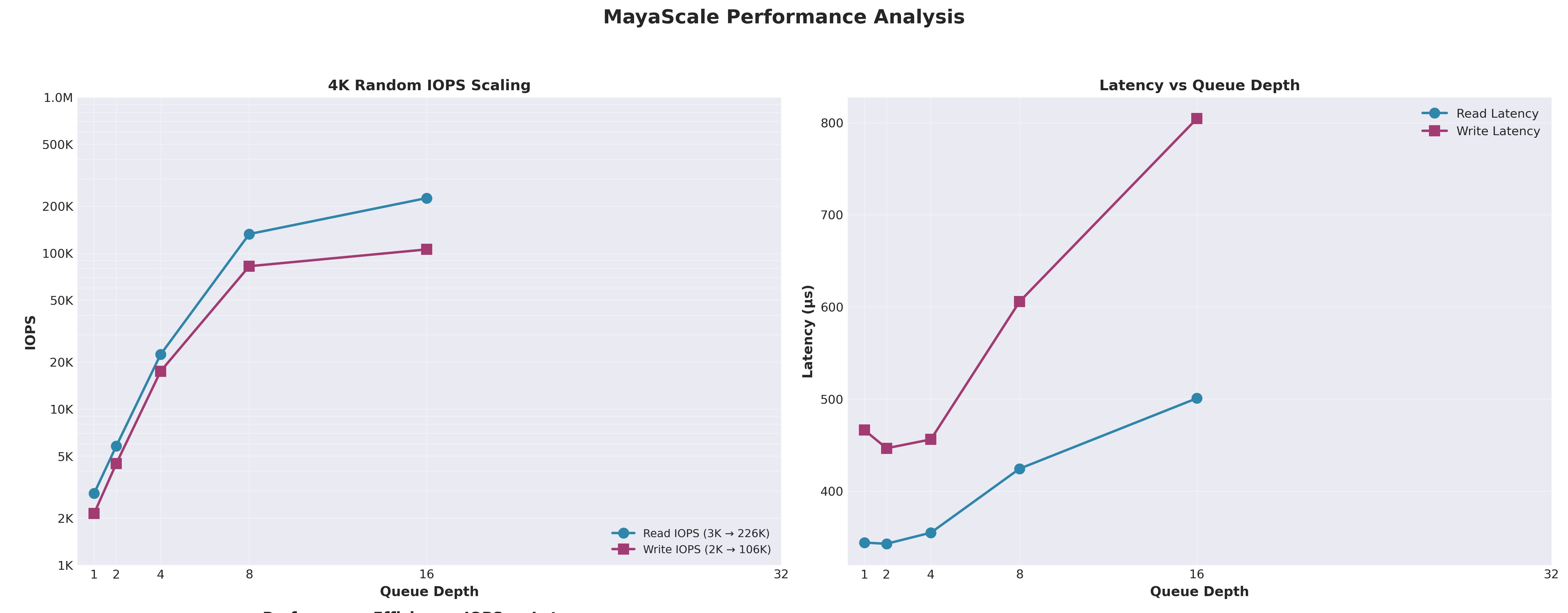
Standard Performance - 226K IOPS
Additional Tiers: Medium (L12aos_v4), High (L24aos_v4), and Ultra (L32aos_v4) tiers are defined and available for deployment. Performance validation testing in progress.

Why MayaScale on Microsoft Azure?

Sub-Millisecond Performance

Validated 344µs QD1 read latency with NVMe-oF. Pool local NVMe from Azure L-series VMs for shared block storage that rivals direct-attached performance.

Active-Active HA

Both nodes serve I/O simultaneously. Sub-second failover with no downtime. 99.99% availability for mission-critical databases.

90% vs Traditional SAN

No expensive SAN infrastructure required. Pool local NVMe from Azure L-series VMs. Policy-based deployment vs $200K+ traditional SAN solutions.

Performance That Changes Everything

Validated Performance Metrics (Standard Tier)

SNIA-compliant FIO testing on Azure Standard_L4aos_v4 (4 vCPU, 3x NVMe, Nov 2025):

  • 344µs read latency @ QD1 (real application performance)
  • 466µs write latency @ QD4 with Active-Active replication
  • 226K read IOPS peak validated performance
  • 106K write IOPS peak validated performance

vs Traditional Solutions

Solution Latency Improvement
MayaScale 0.14ms Baseline
Azure Premium SSD 2-5ms 10-35x slower
Traditional SAN 3-10ms 20-70x slower
Network Storage 5-15ms 35-100x slower

Native Azure Integration

Azure L-Series VMs

Optimized for Laosv4, Lasv4, Lsv4 storage-optimized instances with local NVMe drives. Pool NVMe resources across multiple VMs.

Accelerated Networking

Leverages Azure's 10-50 Gbps accelerated networking for maximum NVMe-oF throughput with minimal latency overhead.

SQL Server & Oracle

Certified for mission-critical databases. Active-Active HA ensures 99.99% uptime for production workloads.

Azure Kubernetes Service

High-performance persistent volumes for stateful applications. CSI driver for dynamic provisioning.

Virtual Desktops (AVD)

Low-latency storage for Azure Virtual Desktop deployments with thousands of concurrent users.

Azure Monitor

Full integration with Azure Monitor, Application Insights, and Log Analytics for performance tracking.

NVMe-over-Fabrics Architecture

How MayaScale Delivers Sub-Millisecond Performance

MayaScale pools local NVMe drives from Azure L-series VMs using NVMe-over-Fabrics (NVMe-oF) protocol:

  • Local NVMe SSDs: Direct-attached NVMe drives on L-series VMs (Laosv4, Lasv4, Lsv4)
  • NVMe-oF Protocol: NVMe-over-TCP for cloud-native shared storage
  • Active-Active Clustering: Both nodes serve I/O simultaneously
  • Server-Side Replication: MD RAID-1 for data redundancy
  • Standard iSCSI Compatibility: Also supports iSCSI initiators

High Availability

  • Active-Active Design: Both nodes handle I/O concurrently
  • Sub-Second Failover: Automatic failover in <1 second
  • No Shared Storage: Cloud-native architecture without SAN dependency
  • Data Redundancy: Synchronous replication across nodes
Active-Active HA Deployment
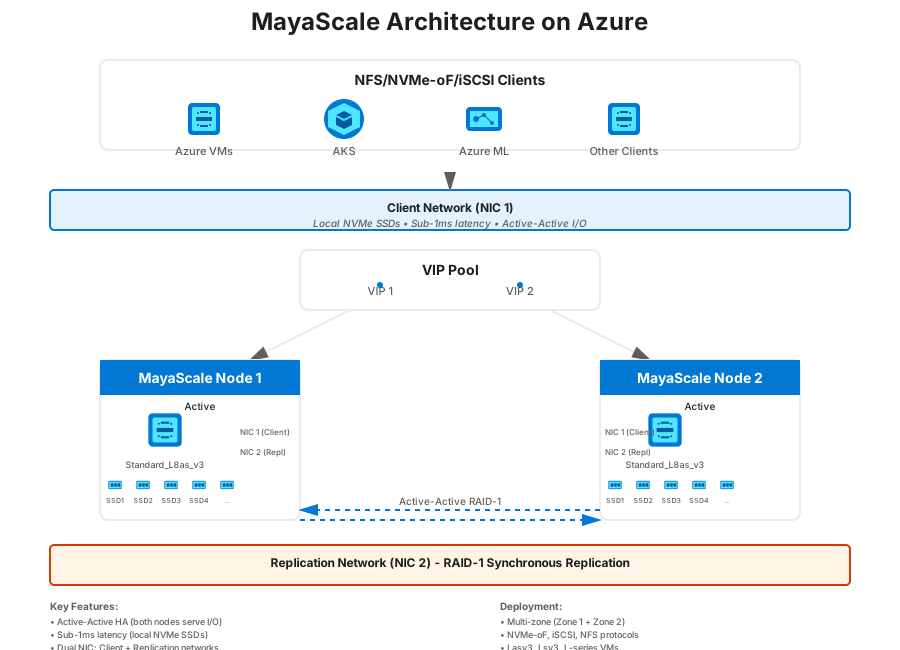
MayaScale Architecture on Azure

Dual NIC architecture with local NVMe SSDs for sub-millisecond latency. Both nodes actively serve I/O with synchronous RAID-1 replication across zones.

Perfect For These Azure Workloads

Mission-Critical Databases

SQL Server, Oracle, PostgreSQL, MySQL with 99.99% uptime and validated sub-millisecond latency:

  • Active-Active HA for zero-downtime maintenance
  • 344µs QD1 latency for transaction processing
  • Reduce database licensing costs with better performance/VM

NoSQL & Real-Time Analytics

Cassandra, MongoDB, ScyllaDB, Redis with ultra-low latency requirements:

  • Sub-millisecond reads for real-time queries
  • High IOPS for distributed databases
  • Persistent storage for in-memory databases

Virtual Machines & VDI

Hyper-V, VMware on Azure, Azure Virtual Desktop with shared boot LUNs:

  • Fast boot times with NVMe-oF boot disks
  • VM mobility with shared block storage
  • Thousands of concurrent VDI users

AI/ML & High-Frequency Trading

GPU workloads and latency-sensitive applications where microseconds matter:

  • Fast data loading for AI training pipelines
  • High-frequency trading with sub-ms storage
  • Real-time inference with low-latency access

Deployment Options

Azure Marketplace

One-click deployment with ARM templates.

  • Automatic billing through Azure subscription
  • Pre-configured Active-Active HA setup
  • Integrated with Azure Portal
  • Production-ready in under 15 minutes
Deploy from Marketplace

Terraform Deployment

Infrastructure-as-Code for automation.

  • Full control over configuration
  • Version-controlled infrastructure
  • Deploy to multiple regions/subscriptions
  • GitOps-ready workflows
Get Terraform Modules

Performance Tier Comparison

Policy-based tier selection. Standard tier validated with SNIA-compliant benchmarks. Additional tiers available for deployment with validation testing in progress.

Tier VM Size vCPUs Local NVMe Capacity Target Read IOPS Target Write IOPS Status Use Case
Standard L4aos_v4 4 3x NVMe 2.88 TB 360K 144K ✅ Validated Nov 2025 Production databases, development, testing
Medium L12aos_v4 12 9x NVMe 8.64 TB 1.08M 432K Testing High-performance databases, analytics workloads
High L24aos_v4 24 9x NVMe 17.28 TB 2.16M 864K Testing Maximum performance databases, large capacity
Ultra L32aos_v4 32 12x NVMe 23.04 TB 2.88M 1.15M Testing Ultra high-performance, mission-critical workloads

Note: Standard tier performance validated November 2025 (344µs QD1 latency, 226K/106K IOPS). Medium, High, and Ultra tiers are available for deployment via Terraform with target performance specifications. Validation testing in progress.

Ready to Experience 344µs Latency on Azure?

Deploy MayaScale in minutes. Get validated sub-millisecond performance with 90% cost savings vs traditional SAN. Policy-based Terraform deployment.

Azure Marketplace Contact Sales

Frequently Asked Questions

How does MayaScale achieve sub-millisecond latency?

MayaScale uses NVMe-over-Fabrics (NVMe-oF) protocol to pool local NVMe drives from Azure L-series VMs. This delivers latency that rivals direct-attached storage while providing the flexibility of shared network storage.

What's the difference between Active-Active and Active-Passive HA?

In Active-Passive HA, only one node serves I/O at a time. MayaScale's Active-Active design allows both nodes to serve I/O simultaneously, providing better performance and sub-second failover with no downtime.

Can I use MayaScale with existing Azure services?

Yes. MayaScale integrates with Azure VMs, AKS, Azure Virtual Desktop, SQL Server, and any application requiring high-performance block storage via NVMe-oF or iSCSI protocols.

What Azure regions is MayaScale available in?

MayaScale can be deployed in any Azure region that supports L-series VMs (Laosv4, Lasv4, Lsv4 families). Contact sales for region-specific availability.

How much does MayaScale cost compared to traditional SANs?

MayaScale delivers 90% cost savings vs $200K+ traditional SAN solutions. No shared storage infrastructure required—you only pay for the Azure L-series VMs you use. Standard tier starts with L4aos_v4 instances.

Is there a free trial available?

Yes. Contact our sales team to arrange a proof-of-concept deployment on your Azure subscription. We offer technical support during evaluation.