MayaNAS · cloud-native Lustre · on object storage

Lustre, operationally simplified.

The parallel filesystem the world's largest GPU clusters trust — deployed as a two-node cluster in your cloud account, with object storage as the capacity layer. Lustre, NFS, and SMB serve one namespace from one pool, and one terraform apply stands the whole thing up.

See the architecture → Read the docs free Community Edition · one terraform apply · GCP · Azure
Architecture

Two nodes. One pool. Every protocol.

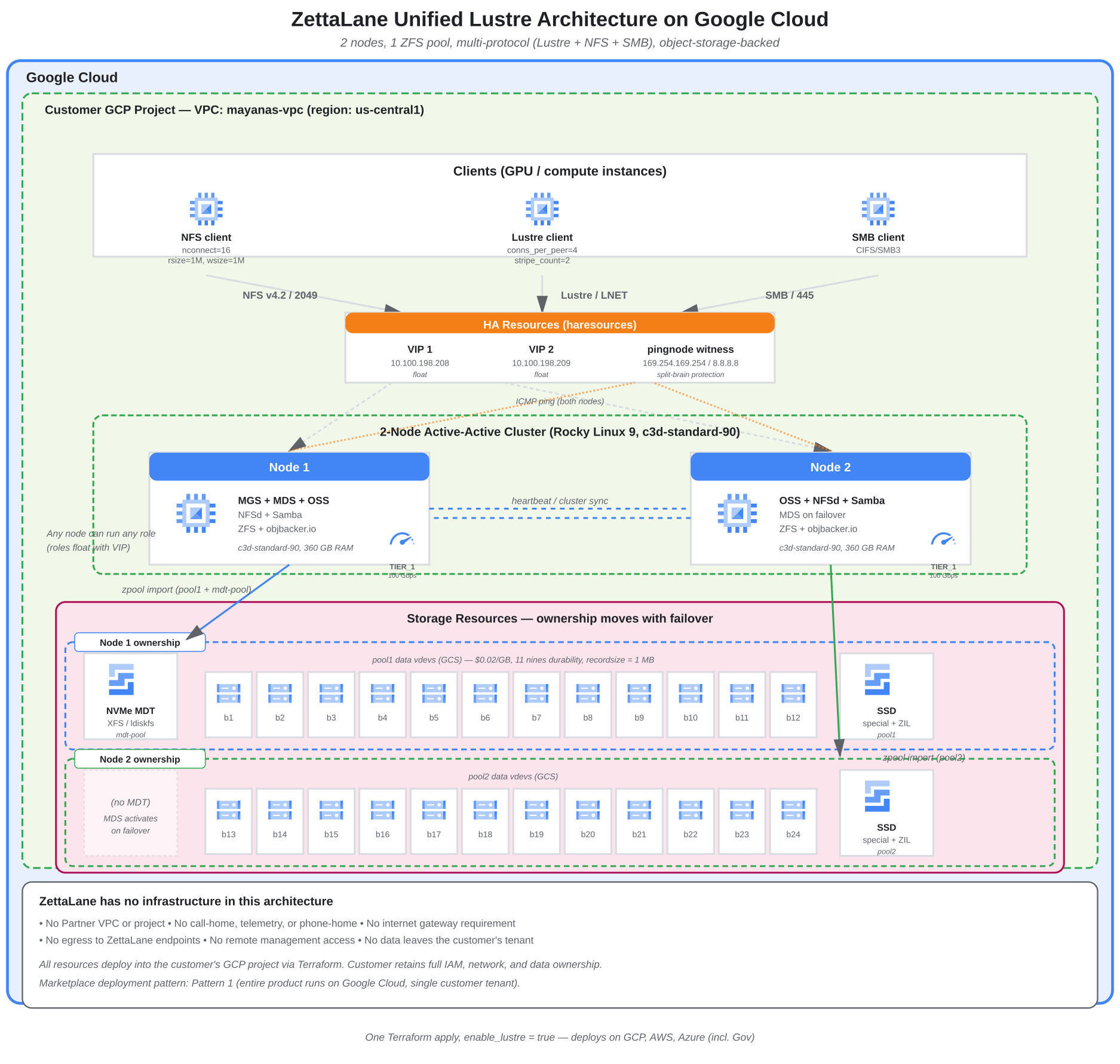
Both nodes run active-active — metadata and object services float between them with the virtual IPs, protected by a witness against split-brain. The data lives in object storage buckets behind ZFS, with NVMe for metadata and SSD for the log — so capacity grows at bucket prices while clients see a normal high-performance filesystem.

ZettaLane unified Lustre architecture on Google Cloud: GPU clients over Lustre, NFS, and SMB; floating VIPs with witness; two-node active-active cluster; object storage bucket vdevs with NVMe metadata and SSD log

Unified Lustre architecture on Google Cloud — the same shape deploys on AWS and Azure.

Why this Lustre

Parallel-file performance without the parallel-file operations.

Multi-protocol, one namespace

Lustre for GPU training, NFS for tools and notebooks, SMB for everyone else — the same files, the same pool, no copies between silos.

Object storage is the capacity

Data lives in S3, GCS, or Blob buckets behind the filesystem — capacity grows at bucket prices, durability comes from the cloud, and nothing is staged or copied in.

Active-active availability

Every service can run on either node; roles and virtual IPs migrate on failure with a witness guarding against split-brain. Clients reconnect and training continues.

Standard clients everywhere

Stock Lustre and NFS clients — GPU instances, managed Kubernetes, existing HPC images. Nothing proprietary to install or maintain on the compute side.

Entirely in your account

Every resource deploys into your own project and VPC. No vendor infrastructure, no call-home, no external endpoints — you keep full IAM, network, and data ownership.

Two nodes, not twenty

A complete Lustre cluster — metadata, object services, and NAS — on a two-node footprint. The operational surface of a filer, the throughput profile of a parallel filesystem.
Kubernetes

Mounted by the driver you already use.

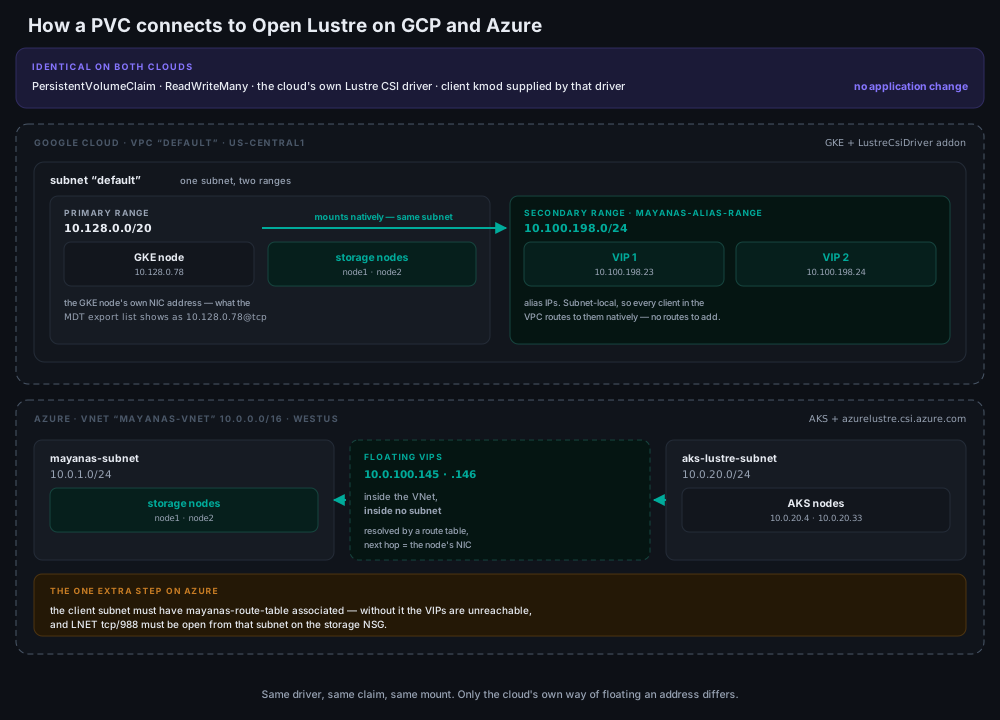
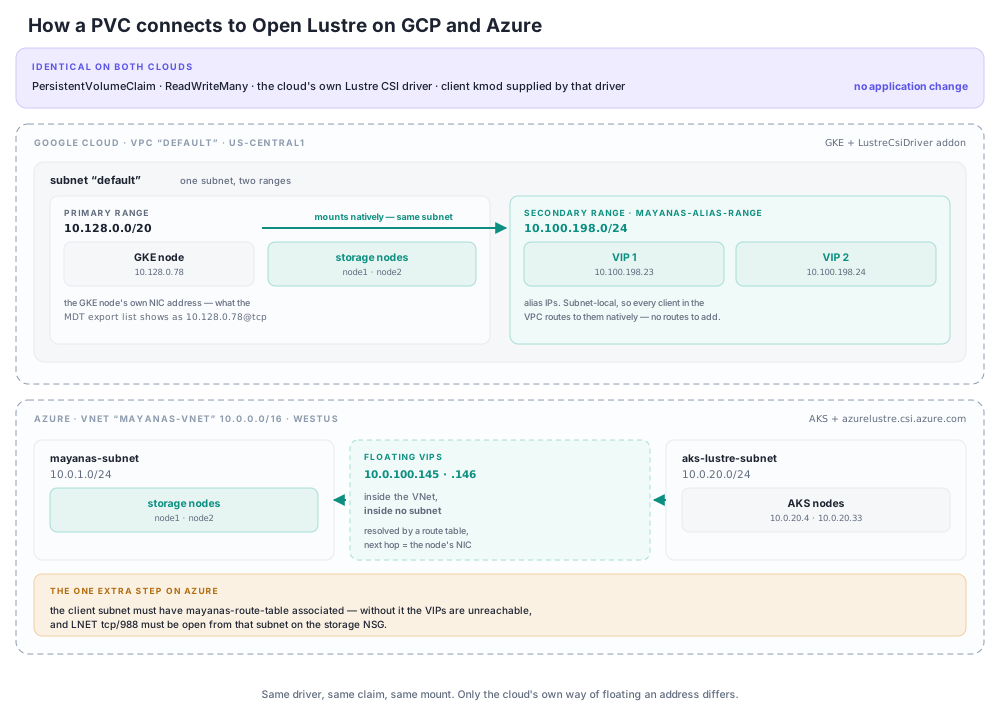
Google and Microsoft each ship a Lustre CSI driver with their managed Kubernetes service — and both of them mount this filesystem. The same PersistentVolumeClaim, the same ReadWriteMany volume, the same YAML your workloads already have. Each driver supplies the Lustre client on the nodes, so pods mount a shared filesystem with nothing to build and nothing of ours running in your cluster.

The same PersistentVolumeClaim on both clouds. On Google Cloud the floating VIPs are alias IPs from a secondary range of the subnet, so clients route to them natively. On Azure the VIPs sit inside the VNet but outside every subnet, resolved by a user-defined route table.

The workload layer is identical on both clouds — same driver, same claim, same mount. Only the way each cloud floats an address differs. Addresses shown are from live clusters.

The Kubernetes guide — cluster setup for each cloud, the manifests, and what to check when a mount does not come up.
Community Edition

Open, free, and yours to run.

Open Lustre Community Edition is the whole picture — two storage nodes, active-active HA, every protocol — deployed into your own account and free to run. There is no managed service to buy, no marketplace subscription, and nothing metered. Bring it up for a semester, a grant milestone, or an afternoon of experiments, and tear it down when you are finished. Talk to us for sizing, support, or additional HA pairs.

open-lustre-cloud — the deploy script, the Lustre client installer, and the Kubernetes guide. One command on Google Cloud or Azure; it fetches the terraform modules on first run.

The filesystem your GPUs expect, on the storage your budget likes.

Self-serve with terraform from your cloud marketplace — ready for your most demanding training runs.