MayaScale utilizes instances with local NVMe devices and provides robust NVMe over Fabrics platform to clients that support NVMe/TCP. Deploy MayaScale in 2-node HA configuration if the NVMe devices are temporary storage devices to safe guard against data loss in the event of interuption.
Choose storage optimized virtual machine (VM) sizes Lsv3, Lasv3, and Lsv2-series that feature high-throughput, low latency, and directly mapped local NVMe storage. These VM series come in sizes from 8 to 80 vCPU. There are 8 GiB of memory per vCPU, and one 1.92TB NVMe SSD device per 8 vCPUs, with up to 19.2TB (10x1.92TB) available on the largest VM sizes. Since these local NVMe disks are ephemeral, data will be lost on these disks if you stop/deallocate your VM but MayaScale in 2-node HA solves this problem.
Before configuring MayaScale High Availability create a Service Principal account with sufficient permissions to manipulate disk attachments for proper sharing and fencing, and also storage read-write access to object storage. It also needs sufficient permission to float the virtual IP across multiple instances. By having separate service account for all MayaScale deployments you can enforce proper security measures as the assigned roles are limited to this project instances only.
The service principal account is created from Azure cloud shell or other system where login credentials were already established, and not from the MayaNAS instances Also note that Service principal account is not required if high-availability will not be used. |
az ad sp create-for-rbac --name mayascale-ha \
 --scopes /subscriptions/de1374d24-1027-440d-97e3-574dcc83e7d3f/resourceGroups/mayanas-testing \
 --role contributor

Creating 'contributor' role assignment under scope '/subscriptions/de1374d24-1027-440d-97e3-574dcc83e7d3f/resourceGroups/mayanas-testing'
The output includes credentials that you must protect. Be sure that you do not include these credentials in your code or check the credentials into your source control. For more information, see https://aka.ms/azadsp-cli
{
"appId": "daf98b5b-343a-4119-a08f-4ea837048e41",
"displayName": "mayascale-ha",
"password": "2v28Q~wGzmsvhy4tPeQHDbhDxEQPmUaRZMFnvbC_",
"tenant": "3d2547b6-c040-40bd-7911-edcd62a8b111"
}
|
The above command requires subscription-id and resource group name where Mayascale will be deployed. To find the subscription ID az account show --query id -o tsv de1374d24-1027-440d-97e3-574dcc83e7d3f/ Please make a note of that password or also known as client secret value for Application Registered with Azure Active Directory. This will value will not be displayed again in the Azure portal. |
Here is the sequence of steps involved in deploying High-Availability (HA) MayaScale on Azure cloud platform. The next steps assume you’ve already deployed at two MayaScale instances from Azure marketplace, with desired Availability Set.
mayascale1, mayascale2 with public IPs 20.245.80.251. 20.245.82.185
mayascale.pemConnect to the newly launched Mayascale instances using SSH to setup Service Principal account, which is required only if you are planning to configure HA services. Otherwise you may skip to the next step.
Perform the following steps for mayascale1 and mayascale2
ssh -i ~/.ssh/mayascale.pem azureuser@20.245.80.251 sudo az login--service-principal -u daf98b5b-343a-4119-a08f-4ea837048e41 --tenant b9f7862a-7153-4501-8039-8d9b37d7c0a9 |
{
"cloudName": "AzureCloud",
"homeTenantId": "3d2547b6-c040-40bd-7911-edcd62a8b111",
"id": "56813587-f424-4db0-af19-516c71f5800c",
"isDefault": true,
"managedByTenants": [],
"name": "Pay-as-you-go",
"state": "Enabled",
"tenantId": "3d2547b6-c040-40bd-7911-edcd62a8b111",
"user": {
  "name": "daf98b5b-343a-4119-a08f-4ea837048e41",
  "type": "servicePrincipal"
 }
}
|
Change the MayaScale Administration GUI default password to something random by running
# /opt/mayastor/web/genrandpass.sh |
Or to set your own password
# /opt/mayastor/web/changepass.sh Login name (default admin): Login password: Password again: |
And then restart the web server for password changes to take effect
# /opt/mayastor/web/stop # /opt/mayastor/web/start |
Now you can proceed with High-Availability setup using the Getting Started wizard from Administration Web console available on http://<mayascale1-ip>:2020
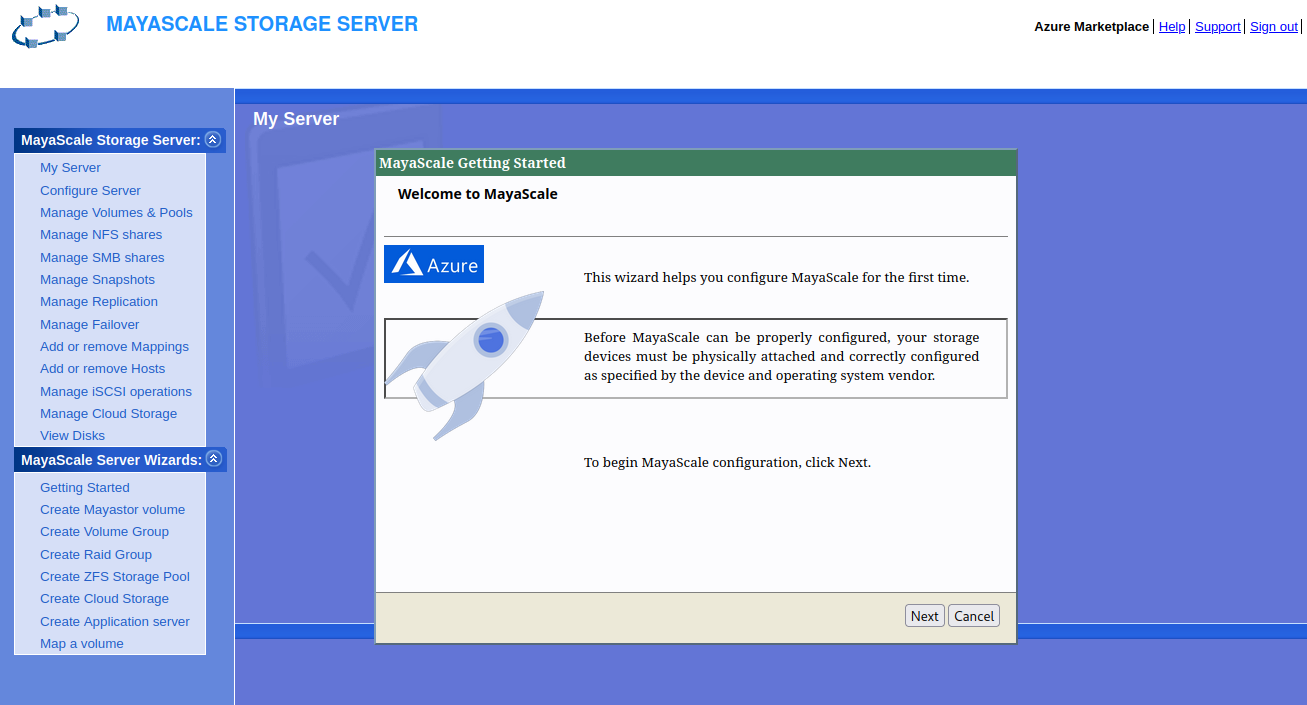
To avoid public network exposure of port 2020 it is recommended to use ssh tunneling with port forwarding as follows ssh -i ~/.ssh/mayascale.pem azureuser@<mayascale1-public-ip> -L 2020:localhost:2020 |
Next proceed to Configure MayaScale