1. Connect to newly launched VM Instance
- Using RDP client connect to MayaData VM instance with the default account name and initial password configured by the cloud provider.
- Change the default password to your own password.
- Optionally create additional users if needed.
2. Launch Administration console
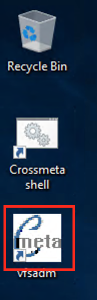
Launch vfsadm Administration Console from the shortcut link in Desktop and Run as Administrator
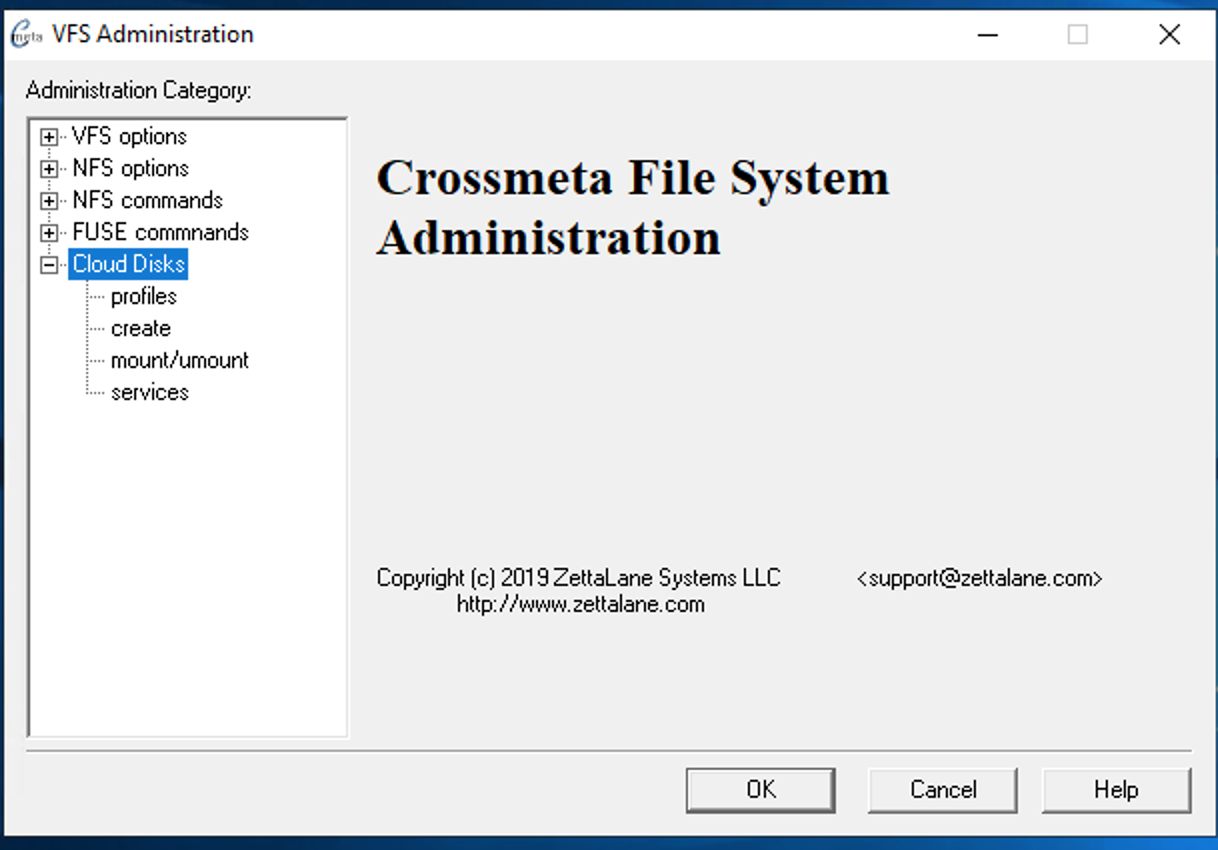
Expand the Cloud Disks in the tree view pane to reveal the following management options
On this page: |
3. Create Cloud Profile
Use profiles → New to create a cloud profile that provides relevant information for accessing the cloud storage from application. To start with the configuration you would need access ID key and secret key generated by your cloud provider from their console settings. It is also possible to skip providing this information, if the compute engine was already authorized to perform S3 object access operations through IAM settings.
For AWS EC2 instance created with IAM role that authorizes S3 operations it may not be required to configure the accessId and accessKey within the software. Instead use the option --accessEC2IAM=ROLE option with objbaker. This will acquire S3 credentials from EC2 machine via IAM role.
Use profiles → New to launch the following dialogs.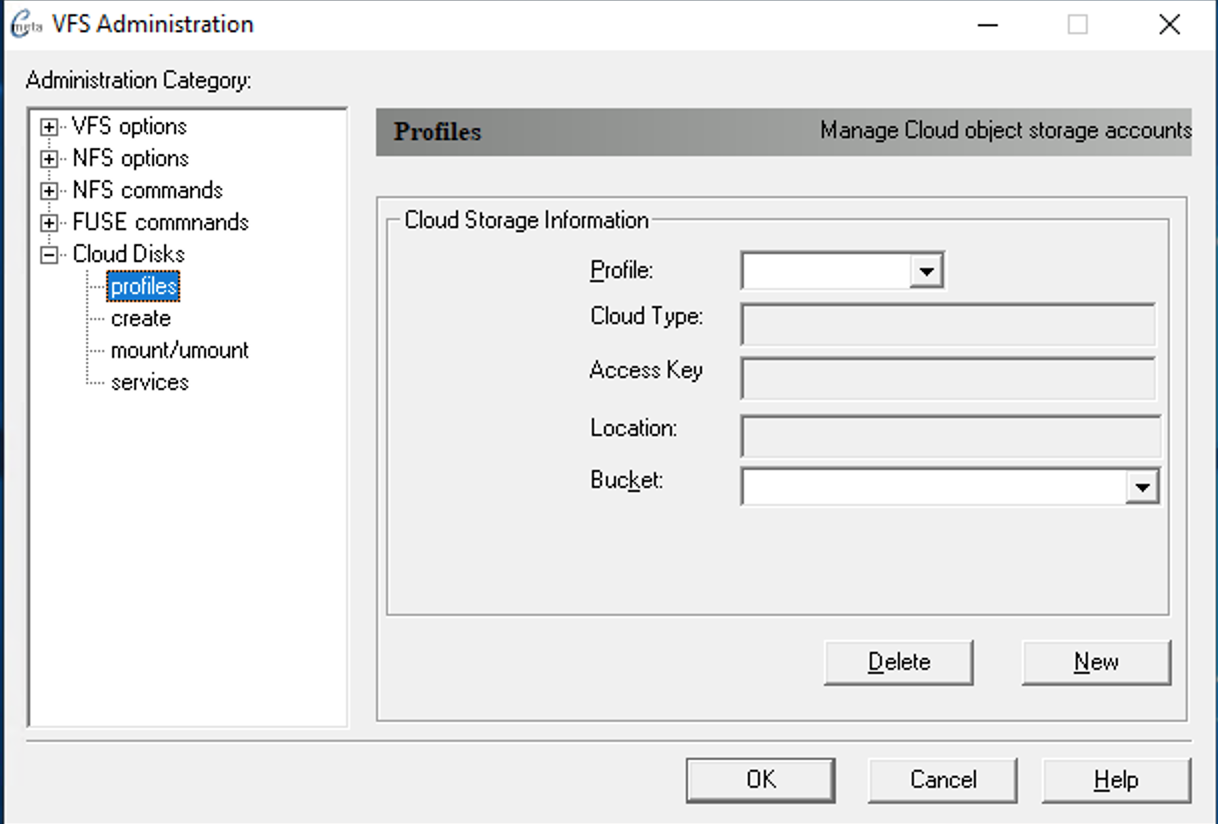
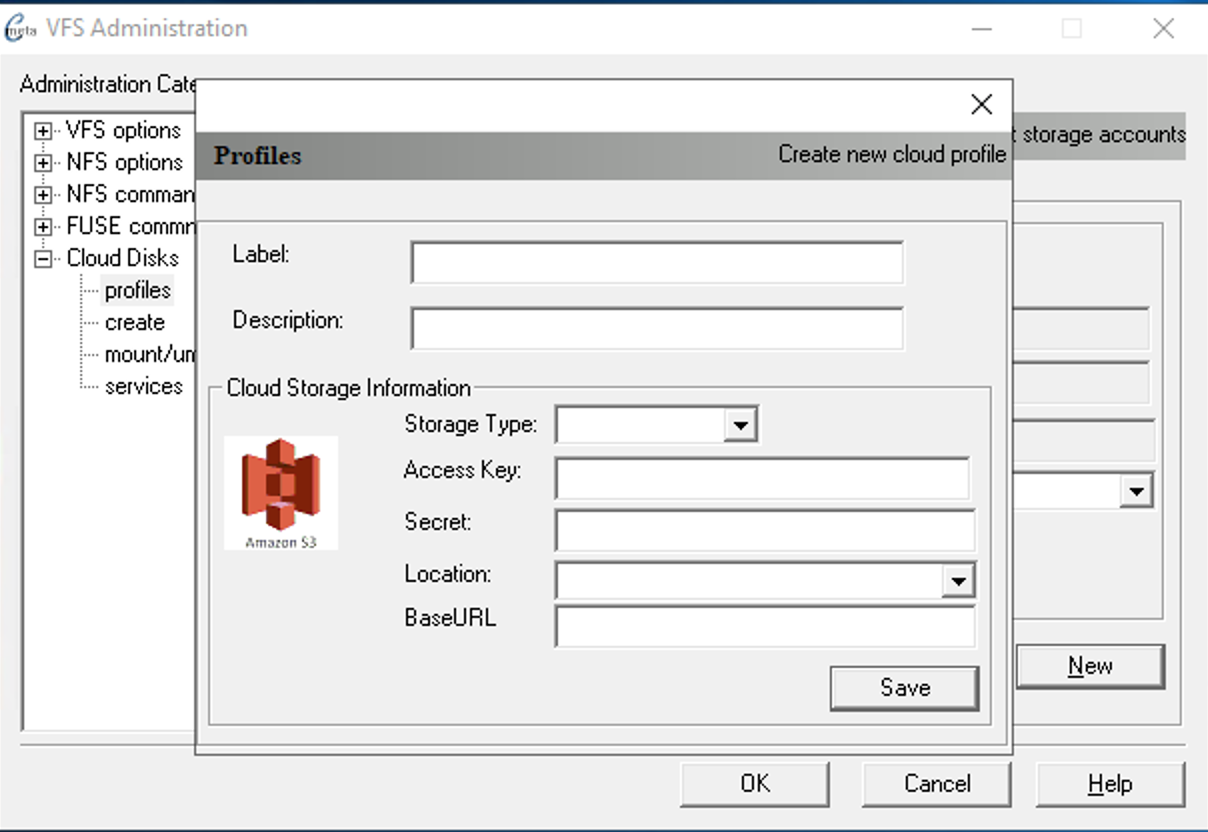
The following dialog shows how to configure cloud profile for Wasabi Technologies which comes under Other S3 generic category. In this configuration BaseURL is required to match their service URLs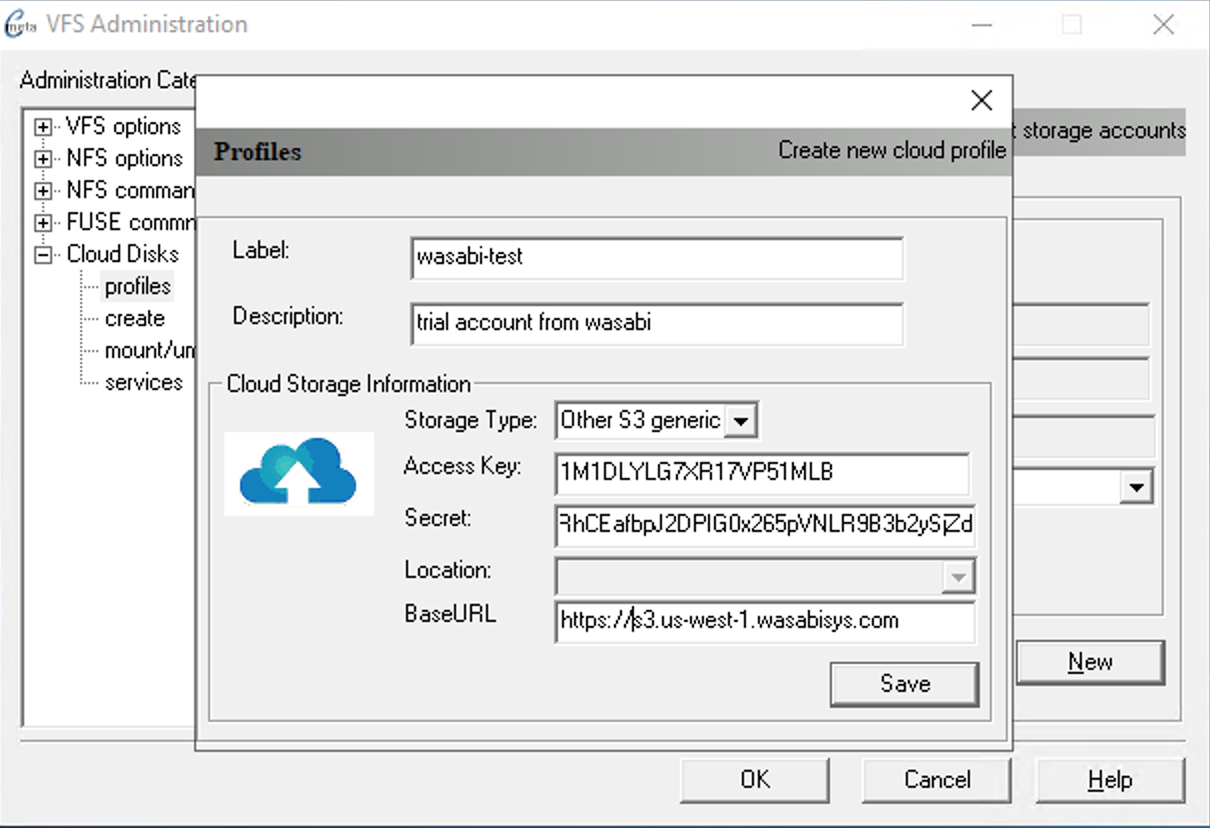
Once configured it will provide a list of bucket/container names that is currently present.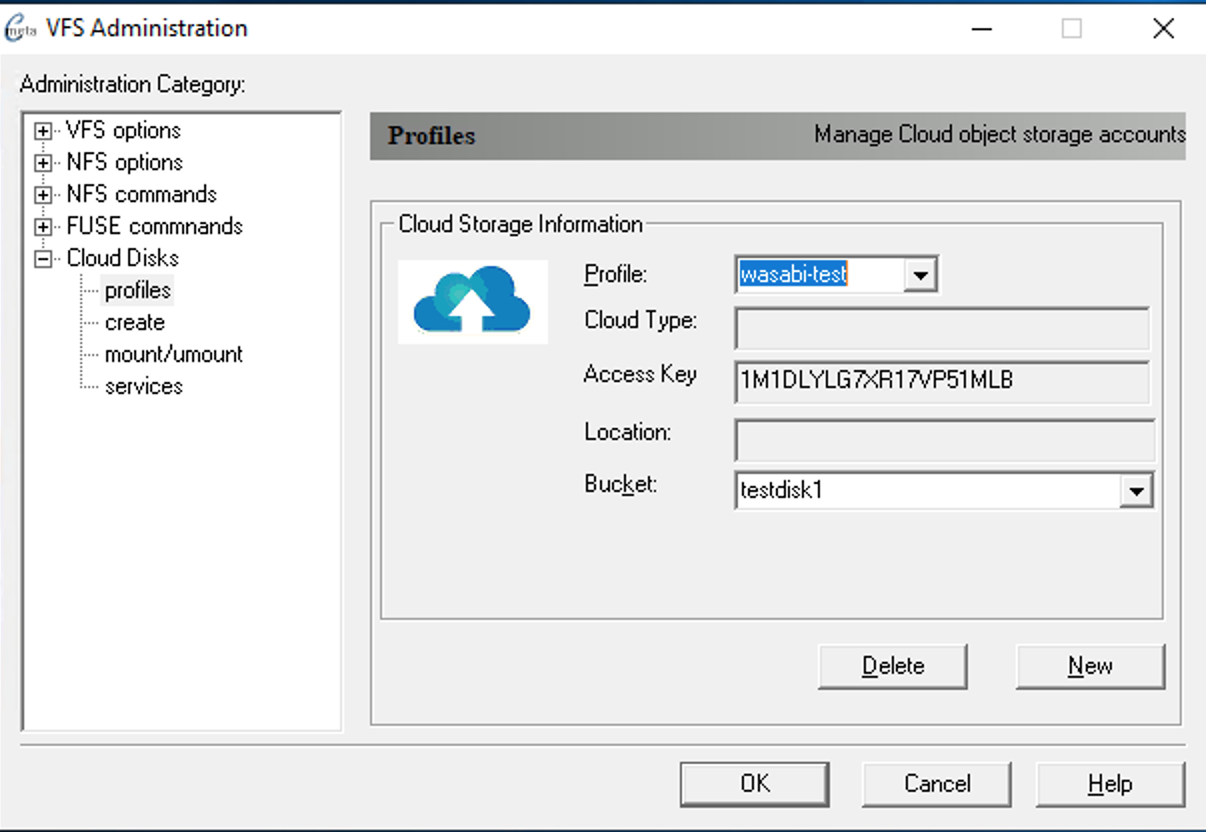
4. Configure your first object storage disk
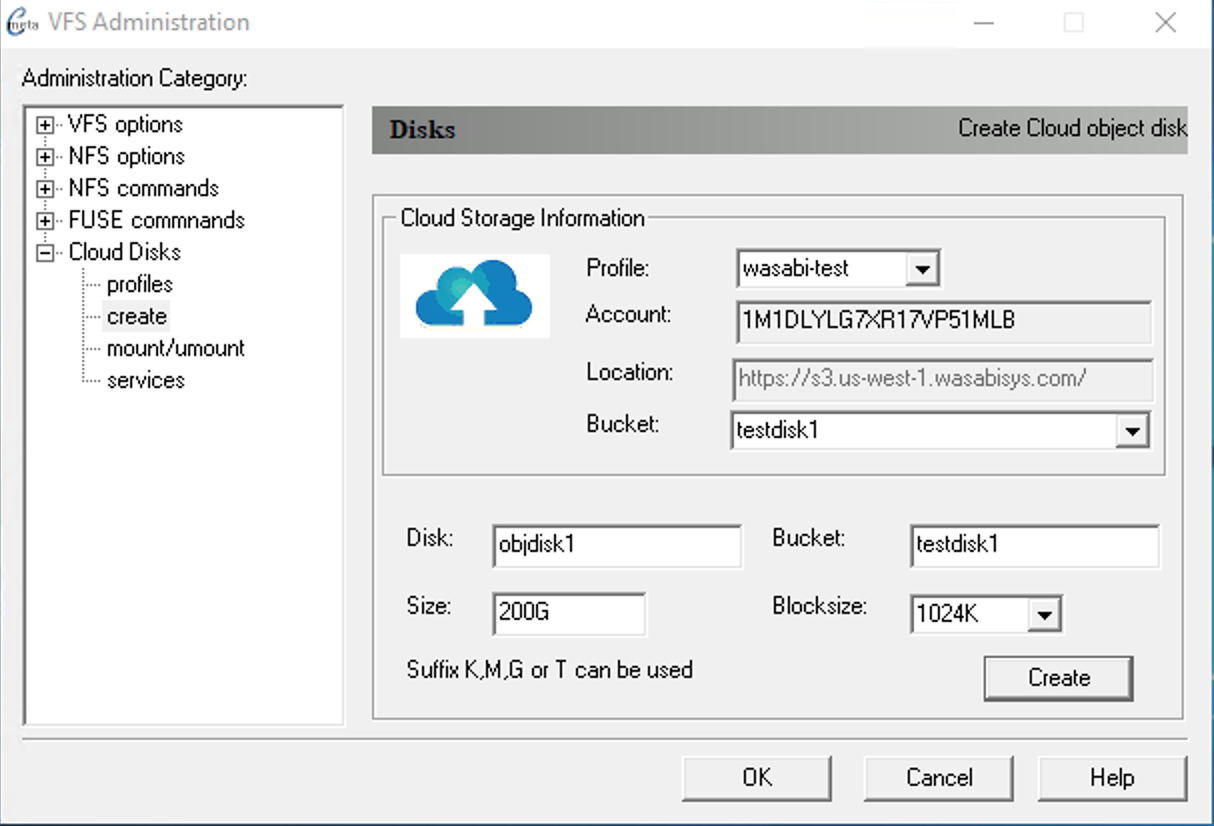
Select the cloud profile to use for creating object storage disk. You can select an existing Bucket from the list or enter one manually which will create a new bucket for you. Logical size of VHDX up to 64TB allowed by Windows
Fill in the following information for the new Disk
- Enter Disk name, which maybe same as bucket name or different.
- If you selected existing bucket the Bucket will be autofilled, otherwise enter a new bucket name to be created.
- Enter Size for the Disk representing the Bucket. This is only a logical size while the bucket storage size is physical. Logical size of VHDX up to 64TB allowed by Windows.
- Select the Blocksize of the physical blocks in the cloud bucket. This would normally match the application blocksize for optimal performance. For NTFS it would match the cluster size of the file system.
- Click Create to proceed with the configuration.
For Windows to make use of object storage bucket we have to initialize the object storage as VHDX image. VHDX is preferred over VHD because of inherent journal feature to protect against unsafe shutdown and also it can support up to 64TB for a single image.
Mount object storage bucket
For Windows to make use of object storage bucket we have to intialize the object storage as VHDX image. VHDX is preferred over VHD because of inherent journal feature to protect against unsafe shutdown and also it can support up to 64TB for a single image. This step is performed in foreground interactively to make sure it is working before configuring it as service later. In the following example object storage bucket smbtest1 is being mounted. Please make note of the -f option for foreground. Also for filename we chose as extension .vhdx
After the above command finishes the object storage is accessible as V:\mnt\file.vhdx as one giant file with logical capacity as 10TB.C:\Program Files\qemu>dir v:\mnt Volume in drive V is vfsroot Volume Serial Number is 0122-B5C1 Directory of v:\mnt 05/22/2019 07:48 PM <DIR> . 05/22/2019 07:48 PM <DIR> .. 05/22/2019 07:48 PM10,995,116,277,760 file.vhdx 05/22/2019 07:48 PM 1,422 stats 2 File(s) 10,995,116,279,182 bytes 2 Dir(s) 5,242,880 bytes free
Activate VHDX file as virtual disk in Windows with Mount VHDX
- Launch diskmgmt.msc to initialize disk for the first time and assign a drive letter. You may create a file system within Disk Management GUI or from Command Prompt.
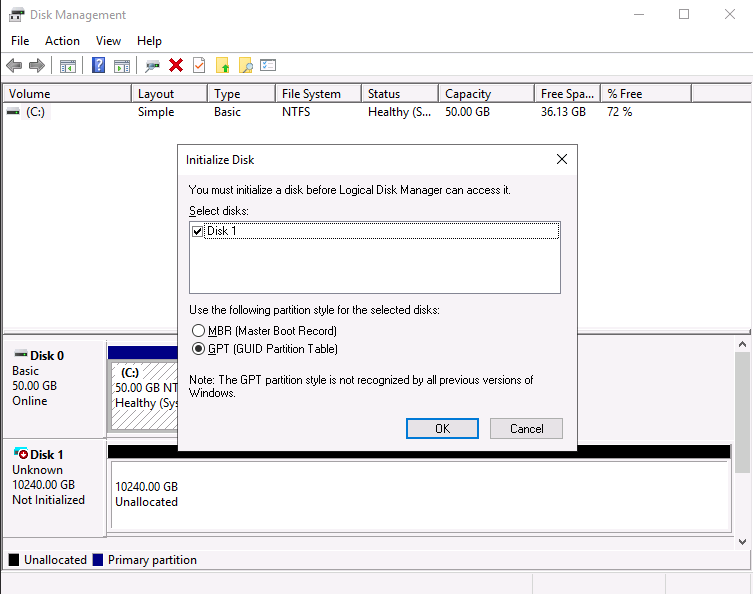
Create a file system NTFS or ReFS. Use the actual drive letter that was assigned from the above command and allocation size of 1MB is chosen to match with the block size used while configuring cloud disk.
c:\users\Administrator> format /fs:ntfs /A:1M /q F:
Windows 2019 supports allocation size of 1MB for NTFS file systems while earlier version limited to 64KB only. This means NTFS created with 1MB allocation size may not be recognized by older Windows.
Detach the virtual disk
Stop the objbaker program to proceed configuration as service
From Desktop → Crossmeta command shell running as administrator
The above command would stop the objbacker program that is running inside another Command Prompt Window.
5. Register the object storage disk as service
- Once cloud disk was setup to Register it as service program
Right-click on Disk and select Register from popup menu.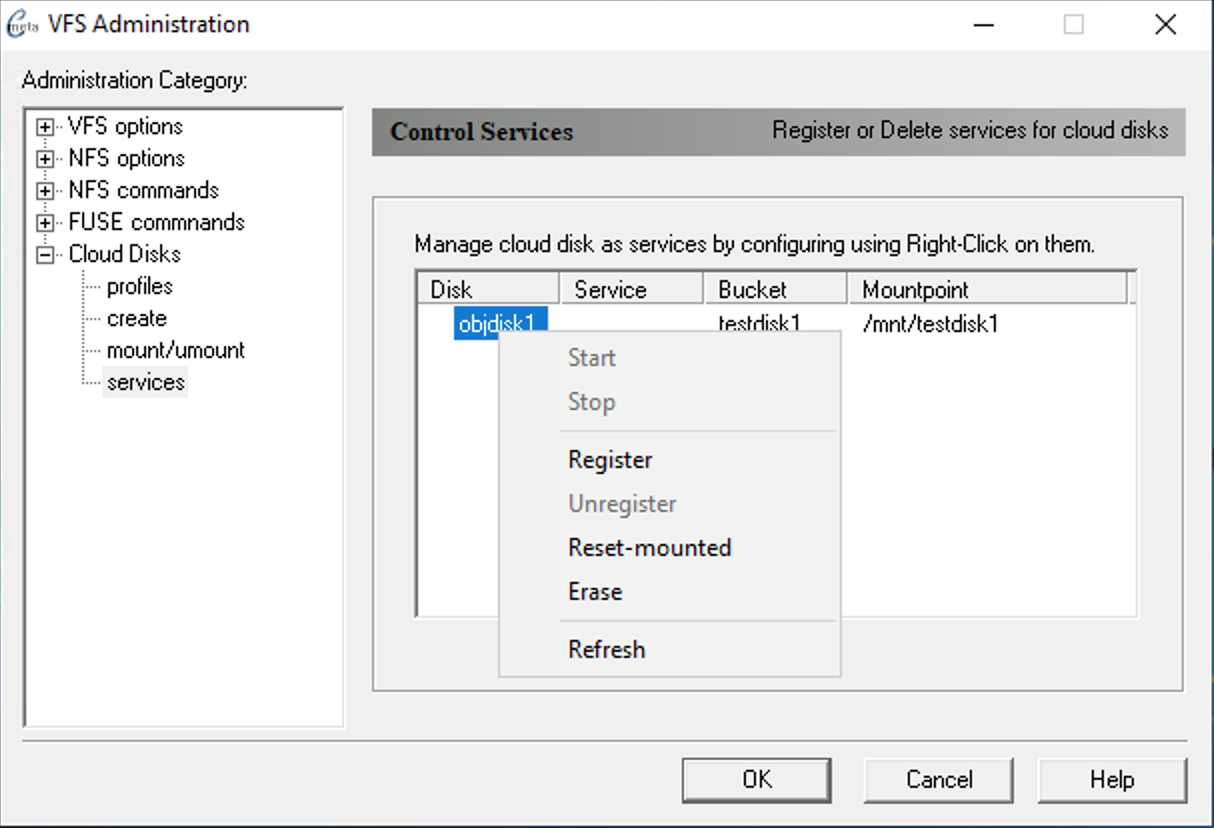
- In the Register cloud disk service you may accept the default values or change accordingly.
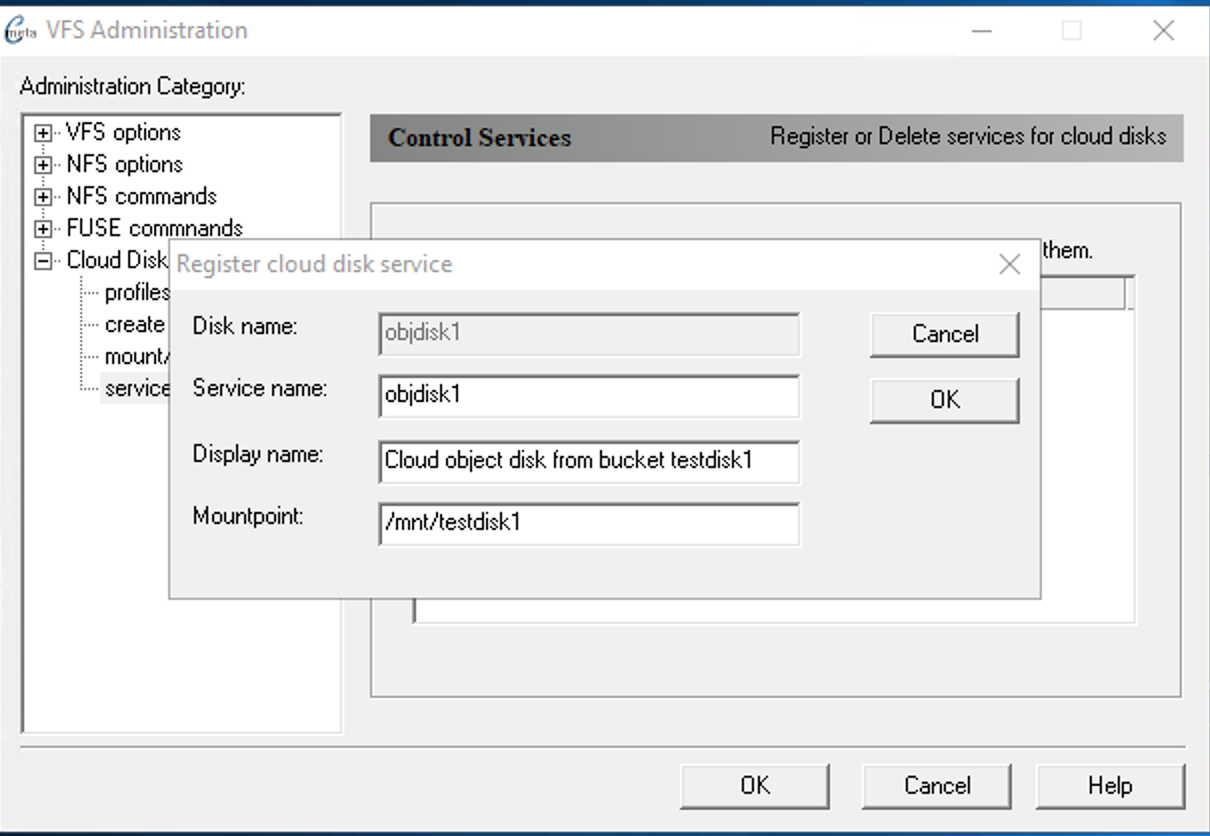
- To start the service Right-click on Disk and select Start from popup menu.
After the above command finishes the object storage is accessible as V:\mnt\file.vhdx as one giant file and in this example it shows logical capacity as 10TB.
C:\Program Files\qemu>dir v:\mnt
 Volume in drive V is vfsroot
 Volume Serial Number is 0122-B5C1

 Directory of v:\mnt

05/22/2019  07:48 PM    <DIR>          .
05/22/2019  07:48 PM    <DIR>          ..
05/22/2019  07:48 PM10,995,116,277,760 file.vhdx
05/22/2019  07:48 PM             1,422 stats
               2 File(s) 10,995,116,279,182 bytes
               2 Dir(s)       5,242,880 bytes free
6. Configure the object storage disk as VHDX
For Windows to make use of object storage bucket we have to initialize the object storage as VHDX image. VHDX is preferred over VHD because of inherent journal feature to protect against unsafe shutdown and also it can support up to 64TB for a single image
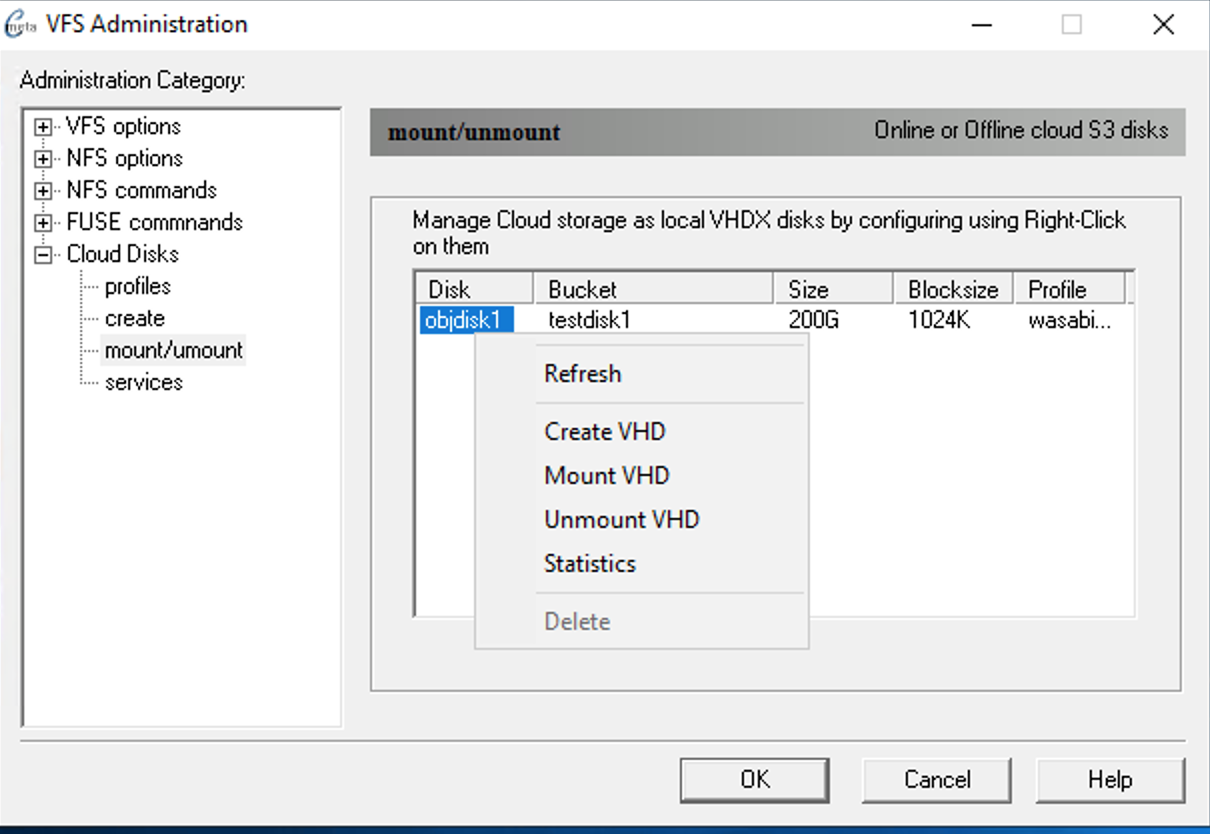
- To create new VHDX image click mount/umount
- Select Disk and Right-Click and choose Create VHD menu option
Click mount/umount
7. Mount the VHDX image of object storage disk
- Select Disk and Right-Click to choose Mount VHD menu option
- Launch diskmgmt.msc to initialize disk for the first time and assign a drive letter. You may create a file system within Disk Management GUI or from Command Prompt.
Create a file system NTFS or ReFS. Use the actual drive letter that was assigned from the above command and allocation size of 1MB is chosen to match with the block size used while configuring cloud disk.
c:\users\Administrator> format /fs:ntfs /A:1M /q F:
Windows 2019 supports allocation size of 1MB for NTFS file systems while earlier version limited to 64KB only. This means NTFS created with 1MB allocation size may not be recognized by older Windows.
8. Detach the VHDX image
- Select Disk and Right-Click to choose Umount VHD menu option
Related pages